 Biola University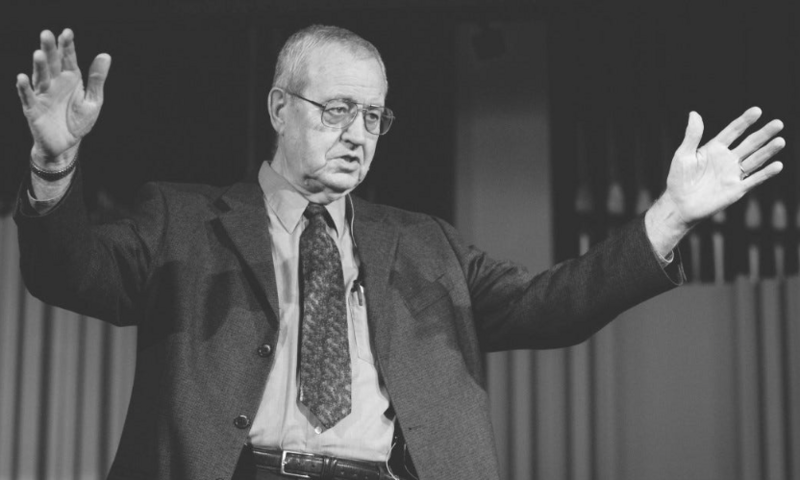
In a wonderful recent episode of the Dallas Willard Podcast, we get to listen to Dallas teach about what it looks like to bring spiritual formation to the church. In so many ways this is a wonderful listen. .
One of the things I love about this talk is that is serves as a sort of “Dallas Willard’s Greatest Hits” album.
You get: “Grace is not opposed to effort, it’s opposed to earning.”
You get: “Life in the kingdom is not about trying, it's about training.”
You get: “Spiritual formation is not about behavior modification.”
It is great.
But we also get a front-row seat to Dallas asking one of the most pressing questions in spiritual formation: How does spiritual formation help the church?
For those of you who don’t know my story very well, Dallas Willard rescued me from a lot. Mostly through his writings, but also through the times I was able to spend with him, Dallas helped me navigate my way out of a mere academic study of Scripture and theology to recognize what our tradition has always known: there is a speculative knowledge of God, a knowledge shared by demons, and there is an affectionate knowledge of God (that specific language, however, I found in my study of Jonathan Edwards).
Willard, of course, has impacted a lot of people, but I’ve met few who actually followed his advice. He didn’t hesitate to tell you what to do when you asked him, and I did. His advice was typically some form of: 1. Memorize Scripture, and 2. Go back to the founders of your denomination (or theological tradition) and drink deeply from that well.
So I did.
One reason I did my Ph.D. in the theology of Jonathan Edwards is that Edwards is one of the deepest wells of American evangelicalism. The initial fruit of that endeavor was the riches I found concerning Edwards’s view of spiritual formation that I published as .
Importantly though, it was taking Dallas’ advice that led me into a stream of thinking about spiritual formation that looked very different from where I started. But that is the gift of working within a broad-minded evangelicalism. When we are deeply impacted by someone, we often seek to become the kind of person they were — and to do the kind of work they did — and in doing so, I was led into a Protestant spiritual tradition that I didn’t know even existed.
In light of this, I want to start by saying how much I appreciate what Dallas was doing in this talk. Three things in particular:
First, the realism of his account.
Dallas believed Scripture taught that we can grow and overcome sin; so Dallas believed that we could grow and overcome sin. There is a realism to all of this that is rarely attended to. Too often, both with sin and with transformation, we have a tendency to talk about them as if they are a black-box (a “black-box” is a box you can’t look in but can only see what goes in and what comes out of it).
When growth is a black box, it feels like alchemy to people. They hear the Christian ideal preached without any sort of path of training articulated, and they imagine that one day they will just wake up and not be angry anymore, or lustful anymore, or greedy anymore. When sin is a black-box, we don’t actually look at our sin directly, and therefore fail to see the deep desires and beliefs that fund it. We live lives driven by desires and beliefs we have no idea we have, imagining that one day God will zap us and we’ll be transformed.
When sin is a black box, we just try hard not to sin and fail to address the fact that we long to sin. When growth is a black box, the Christian life inevitably becomes self-help.
Second, the centrality of Bible exposition in his account.
The second thing that is clear in Dallas’ account is that we need teaching, not just any teaching, but a deep biblical exposition about life with God. Dallas had a realism about transformation but also a realism about the biblical claims on our life (). He really believed what the Bible said about life and he believed it was something available to us.
Third, the developmental nature of his account.
Finally, Dallas understood that there is a developmental nature of the Christian life. He even mentions how the beginning of the Christian life is filled with consolation, and how God weans us off of consolation to mature our faith (this is the theme of my most recent book, ). [Also, as a total side comment, .]
What Willard highlights is that God’s work of maturation is surprising to us. Even though this maturation is exactly what Scripture portrays, we are still often blindsided by it. Willard’s response is to call us into the reality of the life of faith, which is a life beyond trying. But what does this mean?
One of Willard’s emphases is that we are not merely called to try in the Christian life. Too many leave a sermon thinking, “I guess I need to try that.” On this kind of account, the Christian life is just something we need to learn how to do correctly. It is like learning a new way to fold your suit in a suitcase so it doesn’t wrinkle (I should try that). This is what too many accounts of spiritual disciplines devolve into. In other words, “trying” is the life-hack approach to formation.
Instead, Willard emphasizes that the Christian life requires a transformation of the person, and that we need to take part in this transformation. Transformation, however, is not something we just do. In fact, we have no power in ourselves to do it. Rather, this is a transformation that is from God (Col. 2:19), even if it is still a transformation that requires training.
In short, I love so much of what Willard is doing in this talk.
and more can be found on Kyle Strobel’s .

.jpg)

_(1).jpg)